English
Email

Pseudorabies gE Virus (wild) (PRV-gE) Nucleic Acid Test Kit (Lyophilized)

This is a PCR nucleic acid detection reagent kit used to detect Pseudorabies gE virus (wild) (PRV-gE). Real-time PCR technology has the characteristics of fast, sensitive, highly specific and high accuracy. Utilizing this technology and the FLASHTEST PCR reagent kit, it can accurately diagnose whether pigs carryPseudorabies gE virus (wild) (PRV-gE).
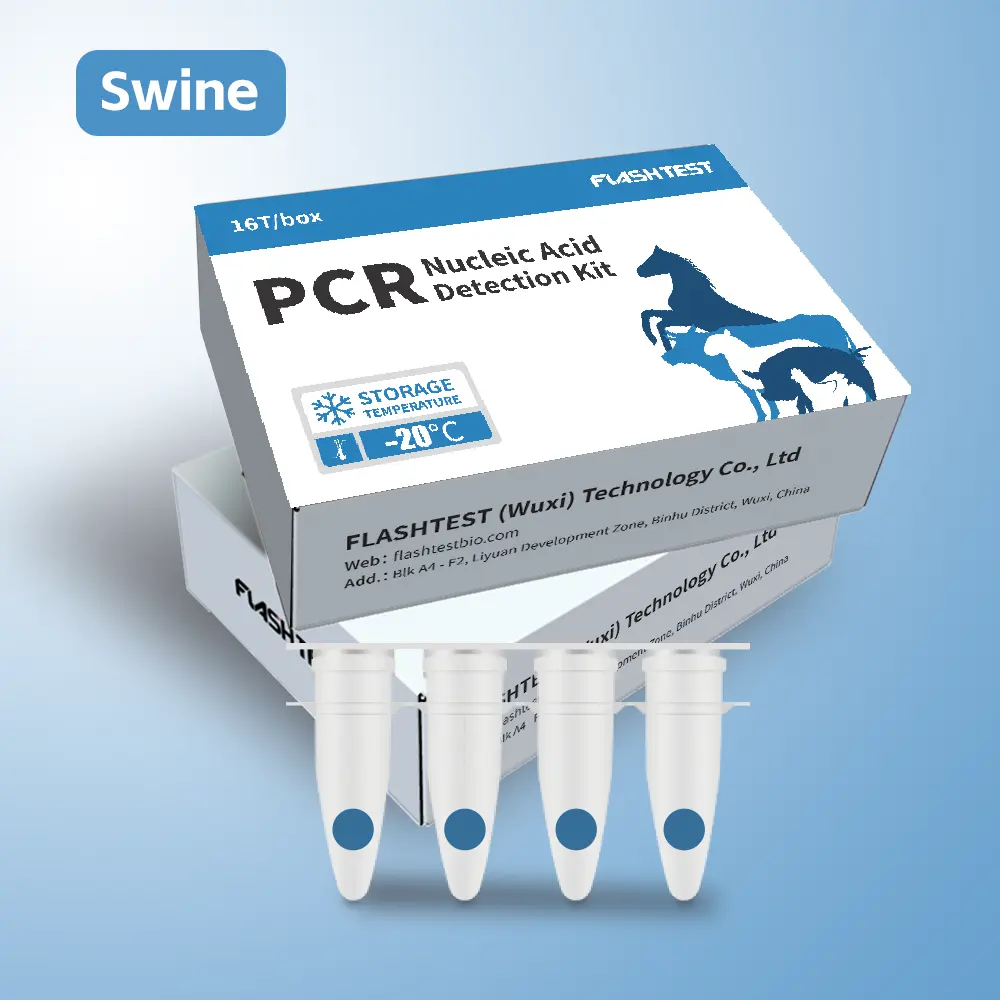
Pseudorabies gE Virus (wild) (PRV-gE) Nucleic Acid Test Kit (Lyophilized).webp
Porcine pseudorabies virus (PRV) is a herpesvirus that can cause significant economic losses in the swine industry. The PRV - gE nucleic acid detection reagent is specifically designed to detect the glycoprotein E (gE) gene of the wild - type PRV. The gE gene is unique to wild - type PRV and is absent in most commercially available attenuated vaccines. This makes it an ideal target for differentiating between wild - type virus infections and vaccinated pigs.
The detection reagent mainly relies on real - time fluorescence quantitative PCR technology. Specific primers and probes are designed based on the conserved regions of the PRV - gE gene. During the PCR amplification process, if the wild - type PRV gE nucleic acid is present in the sample, the primers will bind to the target sequence. As the DNA polymerase extends the primers, a fluorescent signal is generated and amplified. The real - time fluorescence quantitative PCR instrument can accurately monitor the change of this fluorescent signal, and when the signal reaches a certain threshold, it can be determined that the sample is positive for wild - type PRV.


Clinical Applications

  1. Epidemic Monitoring in Swine Farms:Regularly test pig samples in swine farms, including nasal swabs, tonsil swabs, and blood samples. By using the PRV - gE nucleic acid detection reagent, farmers and veterinarians can quickly and accurately detect the presence of wild - type PRV in the pig herd. In large - scale swine farms, sampling and testing can be carried out quarterly to ensure early detection of potential wild - type virus infections. Once detected, immediate isolation and disinfection measures can be taken to prevent the spread of the virus within the farm.

  2. Differential Diagnosis between Wild - type Infection and Vaccination:In regions where PRV vaccination is widespread, it is crucial to distinguish between vaccinated pigs and those infected with wild - type virus. The PRV - gE nucleic acid detection reagent can accurately identify whether a pig is infected with wild - type PRV, even if the pig has been vaccinated. This is important for disease control and prevention, as different measures need to be taken for vaccinated and infected pigs. For example, if a vaccinated pig tests positive for PRV - gE, it indicates a wild - type virus infection, and more strict biosecurity measures should be implemented.

  3. Quarantine and Import/Export Control:At border checkpoints and quarantine facilities, the PRV - gE nucleic acid detection reagent is used to screen pigs and pork products being imported or exported. This helps prevent the international spread of wild - type PRV. If a batch of imported live pigs tests positive for PRV - gE, appropriate measures can be taken, such as quarantine, culling, or rejection of the shipment, to safeguard the domestic swine industry.

  4. Research on PRV Epidemiology and Pathogenesis:The detection reagent provides valuable support for scientific research on PRV. It allows researchers to study the genetic characteristics, transmission patterns, and pathogenic mechanisms of wild - type PRV. By analyzing a large number of clinical samples, they can gain a better understanding of how the wild - type virus spreads and causes disease, which is essential for the development of more effective prevention and control strategies.


10.png

Features of Pseudorabies gE Virus (wild) (PRV-gE)

This farm animals PCR detection reagent screens for pathogens like Pseudorabies gE virus (wild) (PRV-gE). It uses drying technology for normal temperature transportation and frozen storage. Other key features include:

  • Disposable pipette, stable pipettor, simplified workflow

  • Internal reference genes are used to verify results, eliminating the need for guessing.

  • Freeze-dried form, transported at room temperature

  • Available in small, flexible packaging that can be ordered according to your needs


Specification of Pseudorabies gE Virus (wild) (PRV-gE)

BrandFLASH TEST
Product NamePseudorabies gE virus (wild) (PRV-gE) Nucleic Acid Test Kit (Lyophilized)
Product Code/Number3210
Specifications16Test/ Box
Testing ItemsPseudorabies gE virus (wild) (PRV-gE)
Testing TargetsSwine
Minimum Detection Limit500 Copies/mL
PrecisionThe coefficient of variation (CV, %) of the Ct values is ≤5%.
Weight0.4kg


Product
Contact With Us
Tel:
+1-707-722-7066
Add:
Blk A4 - F2, Liyuan Development Zone, Binhu District, Wuxi, China

For any inquiries or queries regarding our animal lab test kits and in vitro diagnostic devices, please don't hesitate to reach out to us directly or fill out our online form. We are here to assist you and provide prompt responses to your questions.

Flashtest Blogs
Nov 20-2025
Why Modern Cardiac Troponin T Test Kits Are Essential for Rapid Cardiac Biomarker Screening
Early and accurate identification of cardiac injury has become one of the most critical tasks in emergency departments, outpatient centers, and clinical laboratories. As cardiovascular diseases contin...
Nov 20-2025
Understanding PCR Dog Testing Technology and Its Role in Canine Disease Control
In recent years, molecular diagnostics have reshaped the way veterinarians identify, monitor, and prevent infectious diseases in dogs. Among these diagnostic tools, the PCR dog test stands out as one ...
Nov 20-2025
How Modern Cat Antigen Tests Improve Feline Disease Management
Modern veterinary diagnostics are evolving quickly, and one of the most meaningful advances for pet clinics and cat owners is the improvement of the cat antigen test. As feline viral and bacterial inf...
Home